



Disclosure. This post has affiliate links. If you buy through them, I may earn a commission at no extra cost to you. As an Amazon Associate, I earn from qualifying purchases. I checked the Amazon prices below on 28 October 2026 at about 9.36pm Manila time. Prices, sellers and stock change, so check the live page before you pay.
US daylight saving time ends on Sunday, 1 November 2026. Clocks fall back from 2:00 a.m. to 1:00 a.m. If you would rather not dig out the crown and risk the date jumping the wrong way, a radio-controlled watch is built for that night. NIST says radio-controlled clocks spring forward when DST starts and fall back when it ends. This guide explains what “atomic” on a watch dial really means, where the signal works, what happens when the transmitter is down and who should buy one. For the hands-on date and DST steps on ordinary quartz and mechanical watches, see my guide to setting your watch for daylight saving time without breaking the date.
What Atomic on a Watch Dial Really Means

NIST is clear on this point. Calling a wristwatch an atomic clock is not really true. An atomic clock has an atomic oscillator inside. A radio-controlled watch has a small radio that receives a time code from a place where an atomic clock sits. In the United States that place is NIST Radio Station WWVB near Fort Collins, Colorado, which broadcasts a digital time code on a 60 kHz carrier. The code carries the year, day, hour and minute, plus flags for daylight saving time, leap years and leap seconds. NIST says millions of people across North America use WWVB to sync wall clocks, clock radios and wristwatches.
Between syncs the watch is still a quartz watch. NIST notes that most radio-controlled clocks decode the signal about once a day, often around midnight or in the early morning when the path is darkest at both ends, and that a typical quartz crystal can keep time to within about a second for a few days. Citizen’s own FAQ puts it the same way. If a radio-controlled Citizen is left without signal reception, it runs as an ordinary quartz watch. The radio is for corrections, not for replacing the movement.
Where Radio Sync Works

Coverage depends on the brand and the model. Casio’s G-Shock Multiband 6 page lists reception of standard time radio waves from Japan (two stations), North America, the UK, Germany and China. It says the watch can receive indoors near a window and can run automatic reception up to six times a night. Citizen’s radio-controlled technology page says its watches can receive time signals from transmitters in Japan, China, Germany and the United States, and that available signals differ by model. Citizen’s FAQ adds that you should check the instruction manual for the stations your model supports. The Amazon listing for the Citizen AT8020-54L names radio control in North America, the United Kingdom, Europe, Japan and China.
NIST’s WWVB coverage maps are a rough indicator only and are based on simulated data. Local interference matters as much as distance. NIST lists computer monitors, metal roofs and steel siding as common blockers. Outside the station areas listed by Casio and Citizen, treat radio sync as a travel bonus when you visit those regions, not as a daily feature. Phone-linked Bluetooth models are the usual alternative when no transmitter covers your home country.
Daylight Saving Time and Time Zones
NIST says radio-controlled clocks spring forward one hour at the start of DST and fall back one hour when DST ends, as long as they are receiving the signal and DST is enabled on the watch. Minutes and seconds stay the same across US time zones on WWVB. Only the hour offset changes, and that offset comes from the time zone you set on the watch. If you live in Arizona or Hawaii, NIST says to disable DST on the watch, or pick another zone trick from the manual if your model has no DST toggle.
I am not listing button sequences here. Module steps differ by caliber. Check the manual that came with your watch, or the brand’s support page for your movement number, before you force a sync or change zones.
When the Watch Will Not Sync
Outages happen. NIST’s WWVB station outage log lists periods when the 60 kHz signal was off or intermittent for more than ten minutes. For 2026 that log includes an outage that began at 15:17 UTC on 20 October and ended at 18:32 UTC on 23 October. During a gap like that the watch keeps running on its quartz crystal. It does not freeze. It just stops getting nightly corrections until the signal returns.
NIST’s help tips for stubborn reception are practical. Rotate a desk clock 90 degrees or move a wall clock to a perpendicular wall, because the antenna is directional. Place the watch along a wall or near a window that faces Fort Collins. Keep it a meter or two from computer monitors. If nothing works indoors, try outdoors at night after a power cycle. Metal buildings can block the signal entirely.
Citizen notes the same idea on its technology page. Reception can be hard where there is a lot of radio noise, or where range, topography, buildings or weather get in the way. Citizen also states that a radio-controlled watch only receives time signals and emits no radio signal of its own, so it is fine to wear in a plane or a hospital on that point.
Who Should Buy a Radio Controlled Watch
- Buy one if you live where WWVB, the Japanese stations, the UK or German transmitters, or the Chinese transmitter are reachable and you want the watch to handle DST and nightly corrections for you.
- Buy one if you travel often among those regions and like waking up on local time without a phone app.
- Buy one as a gift for someone who hates setting watches and already lives in a coverage area.
- Look elsewhere if your home country sits outside the listed station areas and you rarely travel into them. A Bluetooth phone-sync watch or a plain quartz watch will serve you better day to day.
- Look elsewhere if you want a mechanical movement. Radio sync is a quartz feature.
Two Picks Worth Knowing
I am keeping this to two live Amazon listings I rechecked for this draft. Prices are at the time of writing.
Casio G-Shock GW-M5610U-1CF

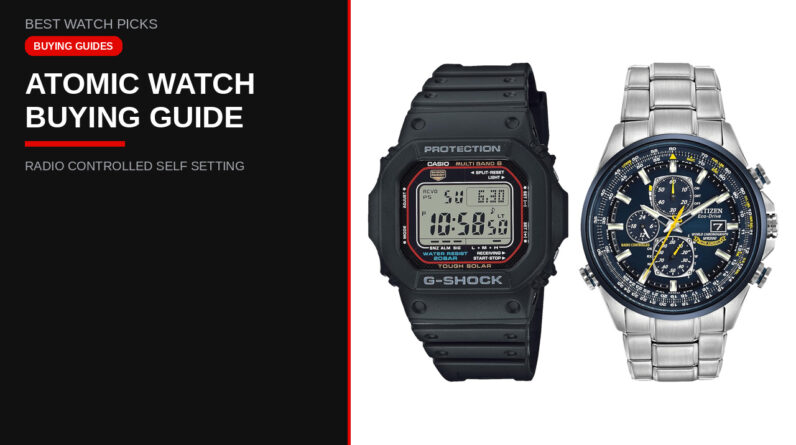
This is the budget digital pick. At the time of writing it was $138.18 on Amazon and in stock. The listing describes Tough Solar power, Multi-Band 6 atomic timekeeping, a Super Illuminator LED backlight, world time, a stopwatch, a countdown timer, five daily alarms, a full auto-calendar, shock resistance and 200 m water resistance. Casio’s Multiband 6 technology page is the source for the six-station reception story above. This ASIN is B0H2KBJ7KG, the -1CF listing. Do not confuse it with older GW-M5610U-1 listings that may be out of stock.
See the Casio G-Shock GW-M5610U-1CF on Amazon
Citizen AT8020-54L Blue Angels World Chronograph A-T
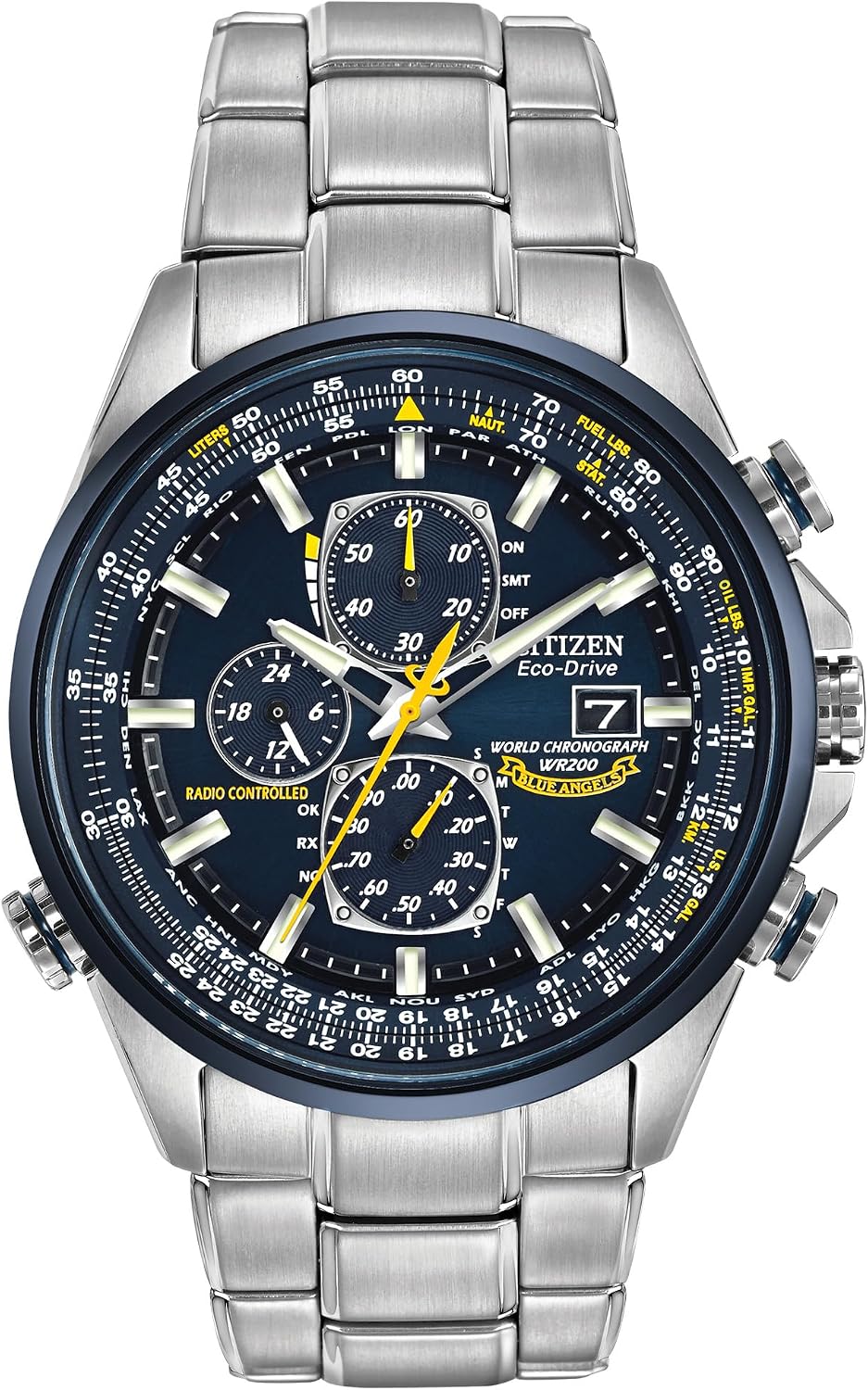
This is the premium analog pick. At the time of writing the new unit was $536.95 on Amazon, shipped and sold by Amazon. The listing names Eco-Drive light power, atomic timekeeping, automatic time in 26 world cities, radio control in North America, the UK, Europe, Japan and China, a 1/20 second chronograph, a perpetual calendar, a power reserve indicator, day and date, an anti-reflective sapphire crystal, a 43 mm stainless steel case, 200 m water resistance and a five year limited warranty. Citizen describes Eco-Drive as fueled by light so you skip the usual disposable cell swap. The watch still uses a rechargeable cell that charges from light. Citizen’s radio-controlled pages are also careful to put the “one second every 100,000 years” figure on the atomic clock that sends the signal, not on the quartz movement between syncs.
See the Citizen AT8020-54L on Amazon
FAQ
Does an Atomic Watch Contain an Atomic Clock?
No. NIST says radio-controlled clocks have a radio inside that receives a signal from a place where an atomic clock is located. The watch itself is quartz between syncs.
Will It Fall Back on Its Own When DST Ends?
NIST says radio-controlled clocks fall back one hour when DST ends, if they are receiving the signal and DST is enabled. Arizona and Hawaii users should disable DST per NIST’s help page.
What Happens During a WWVB Outage?
The watch keeps time on its quartz crystal until the signal returns. NIST logged a WWVB outage from 15:17 UTC on 20 October 2026 to 18:32 UTC on 23 October 2026.
Can I Wear a Radio Controlled Watch on a Plane?
Citizen’s FAQ says a radio-controlled watch only receives time signals and emits no radio signal itself, and that you can use it in a plane or a hospital without concern on that point.
How Is Multiband 6 Different From Citizen Atomic Timekeeping?
Casio Multiband 6 is Casio’s name for receiving six transmitters across Japan, North America, the UK, Germany and China. Citizen describes reception from Japan, China, Germany and the United States, with the exact stations depending on the model. The AT8020 listing names five zones including the UK and Europe.
Bottom Line
A radio-controlled watch is a quartz watch with a nightly radio homework habit. NIST’s WWVB signal, Casio Multiband 6 and Citizen Atomic Timekeeping all point at the same idea. The watch listens for a public time code, corrects itself and otherwise runs like ordinary quartz. That makes DST weekends and travel across covered regions easier. It does not put a cesium oscillator on your wrist. If you live inside a listed station area, the G-Shock GW-M5610U-1CF is the straightforward digital pick at $138.18 at the time of writing, and the Citizen AT8020-54L is the sapphire analog pick at $536.95 at the time of writing. If you live outside those areas, buy for the travel days or choose a different sync method.
Affiliate disclosure. Best Watch Picks is reader-supported. If you buy through the links on this page, I may earn a commission at no extra cost to you. As an Amazon Associate, I earn from qualifying purchases. Prices and availability were accurate at the time of writing and may change. Technical claims follow NIST’s WWVB pages, Casio’s Multiband 6 technology page and Citizen’s radio-controlled technology and FAQ pages. Product features follow the Amazon listings for B0H2KBJ7KG and B008RNKIV8.